
In the Indo-Pacific's new era -- where perception shapes reality faster than treaties -- the real entrapment is not of China or the United States. It is the test Japan has set for itself -- and whether partners like India, acting as balancers rather than accelerants, can help ensure that the story ends in stability, points out Varun Arya.

Notwithstanding the economic complementarities and the host of agreements for deepening economic relation on a host of areas, both sides share common viewpoints on the foreign policy domain and seek common grounds to serve as a counterweight to China, notes Dr Rajaram Panda.

In a region increasingly shaped by competition and coercion, such collaboration strengthens security without confrontation, builds capacity without dependency and promotes order without domination, points out Dr Kumar.
David Perdue said in a post on X that the US-India relationship delivers real results through close cooperation in diverse areas, including defence, energy and through Quad engagement.

History may remember Takaichi Sanae not as the leader who simply accelerated Japanese rearmament, but as one who governed during Japan's transition from an industrial-age security model to a post-industrial strategic member of the global order, points out Varun Arya.

For the foreseeable future, the most likely outcome remains continuation of the status quo. Taiwan will remain self-governing without formally declaring independence, while China continues to apply sustained pressure short of war, predict Krishnan Srinivasan and Manoj Mohanka.
The delegation visiting India during September 5-8 will be led by assistant secretary of state for South and Central Asian affairs Donald Lu.
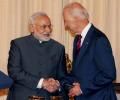
Biden and Modi committed that the US and India will work closely together to win the fight against the COVID-19 pandemic, renew their partnership on climate change, rebuild the global economy in a way that benefits the people of both countries, and stand together against the scourge of global terrorism, the White House said in a readout of the call.

Prime Minister Narendra Modi's visit to the United States this month will set new benchmarks for bilateral ties and some 'really big, historic and exciting' announcements are likely to be made on defence cooperation and boosting India's indigenous military industrial base, the Pentagon has said.

The compulsion behind India and Japan to deepen security cooperation is in response to China's growing political and economic clout and its assertive behaviour in disputed areas. This has been the key driver for bringing both India and Japan closer in the domain of security cooperation, explains Dr Rajaram Panda.

At her daily news conference on Wednesday, White House Press Secretary Jen Psaki was asked how the world's largest and oldest democracies are working together to bring peace in the region amidst the war in Ukraine.
'I don't sense that China wants that kind of conflict or would support that'

The new framework of the ministerial dialogue was initiated in order to provide a forward-looking vision for the strategic partnership between the two countries.

'...it should not delude itself into thinking that India's security or its great-power ambitions will be advanced by those partnerships.'
'Instead, what India should focus on is on riding out the next three-and-a-half years of Trump's presidency with minimal damage to itself.'

The agreement provides for creation of an enabling framework for closer cooperation and interoperability, besides allowing militaries of the two countries to use each other's bases and facilities for repair and replenishment of supplies, the official said.

US Secretary of State Antony Blinken said that the United States is calling on all nations not to have major weapons transactions with Russia. He made these marks after the conclusion of the 2+2 Ministerial Dialogue between the defence and foreign ministers of India and the United States.

Blinken and Indian leaders on Wednesday will discuss a plethora of pressing issues such as the fluid situation in Afghanistan, regional security concerns, COVID-19 response and ways to boost Indo-Pacific engagement, people familiar with the agenda of talks said.

China's behaviour in the post-pandemic geopolitical landscape which may determine the Quad's future trajectory, notes former foreign secretary Shyam Saran.

White House Press Secretary Karine Jean-Pierre said the upcoming visit will affirm the deep and close partnership between the United States and India.

In reflection of their growing congruence in areas of defence and security, the two sides, following the Modi-Mitsotakis talks, agreed to set up an institutional dialogue at the level of national security advisors, and boost defence industrial cooperation.

The 2+2 was attended by Secretary of State Antony Blinken and Secretary of Defence Lloyd Austin and their Indian counterparts S Jaishankar and Rajnath Singh respectively.

Defence is at the heart of the India-United relationship, so it is interesting that General Lloyd Austin, the US secretary for defense, was not among the officials present when Joe Biden met Prime Minister Narendra Damodardas Modi for their first meeting since Biden became president in January.
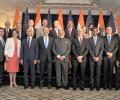
Prime Minister Narendra D Modi's itinerary for his June 21-24 US visit could include an address to a fledgling business advocacy group, the US-India Strategic Partnership Forum.
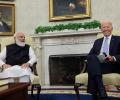
'The message that we intend to leave with at the end of this trip is one of real gratitude for the friendship and the close partnership that President Biden and Prime Minister Modi have enjoyed over the last four years, but also one of tremendous optimism because we see a lot of opportunity in the future.'
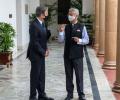
We do not know, because there has been no discussion, no transparency and most likely no real thinking on this matter at our end, observes Aakar Patel.
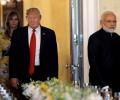
The White House said the two leaders also pledged to continue working together to enhance security and prosperity in the Indo-Pacific region.

The relation between India and China has broad influence on Asia's security and the United States will continue to engage with them to encourage regional stability, the nominee for the Pentagon's top policy post for the Asia-Pacific region said.
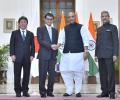
The India-Japan 2+2 dialogue added strategic heft to the special relationship in the wake of growing Chinese assertiveness on regional affairs, points out Dr Rajaram Panda.

Taiwan's Ministry of National Defense said 30 Chinese warplanes made incursions into its air defense identification zone, or ADIZ, the highest daily figure in more than four months.

The Quad summit to be hosted by India in 2024 is likely to enhance New Delhi's strategic intent.

It also comes ahead of a possible visit by President Donald Trump to India later this month. Trump is set to visit India on a two-day trip between February 23 and 26 and both sides are in the process of fine-tuning his schedule, according to sources in New Delhi.

Key to China's decision regarding Taiwan will be its leadership's assessment whether the US will come to Taiwan's defence, explains Jayadeva Ranade, the former senior RA&W officer and China expert.
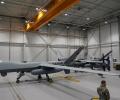
The Agency said it has delivered the required certification notifying Congress of this possible sale on Thursday.

US Secretary of State Micheal Pompeo and Secretary of Defence James Mattis will travel to New Delhi next month for the 2+2 dialogue.
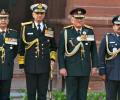
As India's international role expands, so must our capabilities, says Brigadier Gurmeet Kanwal (retd).

With the situation in Ladakh tense and no resolution in sight the trigger to take the India-US relationship to a transformational one is already there, observes Lieutenant General Syed Ata Hasnain (retd).

'Even as discord over US-India trade and commerce colours diplomatic relations, defence relations between the two countries remain on a firm footing,' points out Ajai Shukla.

'As Prime Minister Modi said, our ties are no longer just another partnership. It is a far greater and closer relationship'

'This is a historic juncture when the US is in great need of an alliance with India to strengthen its hands in the fierce struggle with China in the Asian theatre,' points out Ambassador M K Bhadrakumar.

In addition to the attack helicopters, the contract also includes fire control radars; Hellfire Longbow missiles; stinger Block I-92H missiles; night vision sensors and inertial navigation systems.
